Most BBQ tool sets sold in the UK are described as “stainless steel.” What that description does not tell you is which grade of stainless, which matters considerably when you are using a tool over high heat, with fat and salt and smoke involved, for years.
We use 420 grade stainless steel across the Bison Hill tool range. This is not an accident of spec sheet. It is a deliberate choice made after testing alternatives at the fire. This piece explains why.
The stainless steel grades you will encounter in BBQ tools
Stainless steel is a broad category. The two grades you are most likely to encounter in grilling tools are 304 and 420, plus various unnamed soft alloys that are technically “stainless” but will not behave like either.
304 stainless steel
304 is the most common stainless steel in kitchenware. It is excellent for cold applications — cutlery, sinks, food preparation surfaces. It is also widely used in BBQ tools because it is corrosion-resistant, weldable, and inexpensive to manufacture.
The limitation of 304 at the fire is hardness. 304 is a softer grade than 420, which means it is more prone to bending under load. A fork made from thin-gauge 304 that has to support the weight of a 3kg brisket at full extension will flex. Over time, it will deform.
420 stainless steel
420 is a martensitic grade — harder than 304, with higher carbon content. It is used in surgical instruments, industrial cutting tools, and high-quality kitchenware for its rigidity and edge retention. At high heat, it maintains structural integrity better than austenitic grades like 304.
420 is also heat-treatable, which allows manufacturers to increase hardness beyond the base specification. This is why it is the standard in quality cutlery and, in our view, the right choice for live-fire cooking tools.
Unnamed soft alloys
These are the “stainless” tools that rust at the handle junction after a season, or that come out of the dishwasher with orange spots. They are not properly stainless — they are chrome-plated or lightly alloyed carbon steel sold under the “stainless” marketing term. Avoid them.
Why Materials Matter — The Bison Hill Standard
GENERIC ALTERNATIVE
BISON HILL CHOICE
APRON FABRIC
Thin polyester canvas
APRON FABRIC
Heavy indigo denim
TOOL STEEL
Soft alloy / ungraded steel
TOOL STEEL
420 stainless — heat-safe
SERVING WOOD
Imported anonymous board timber
SERVING WOOD
English oak, sourced locally
What this means in practice at the fire
The difference between 304 and 420 is most visible when:
- Lifting heavy cuts — a 420 fork will not flex under a whole chicken or a full brisket. When a pork shoulder has been low-and-slow for eight hours and the bark is set and deep mahogany, the last thing you want is a fork that gives way as you lift it to the board.
- Sustained high heat — 420 maintains its surface integrity better over extended sessions
- Long-term use — 420 tools hold their shape and surface finish over years of use and washing
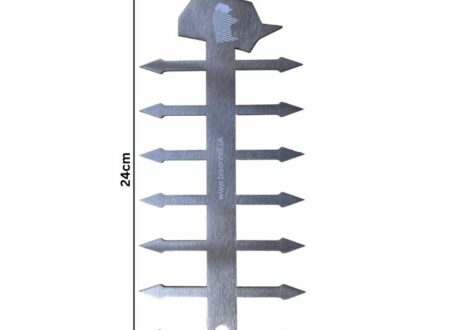
The King Fork, Bison Skewer, and BBQ Blade are all built in 420 stainless. Not because it is the cheapest option — it is not — but because it is the right one for the job.
Ready to upgrade your kit?