
Walk into any kitchen shop and you’ll see shelves full of boards labelled “wooden.” Look closer. Most are pine — soft, porous, and prone to splitting within a year. Others are bamboo, which despite its green credentials is technically a grass: harder on knife edges than any true hardwood, and prone to hairline cracks that harbour bacteria. A few are beech or rubberwood: better, but still a long way from the gold standard.
The best wooden chopping board isn’t just any wooden board. It’s a board made from the right wood, finished properly, and built to last decades — not seasons. That means English Oak. This guide explains why, and points you to one board that does it better than anything else on the market at this price.
Why Wood Beats Plastic and Bamboo
The case for wood over plastic has never been stronger. Research confirms what experienced cooks have known for decades: bacteria drawn into the grain of a hardwood board are unable to reproduce and die off rapidly. On plastic, knife scars create microscopic channels that trap pathogens and are impossible to clean properly — even in a dishwasher.
Bamboo boards, often marketed as the eco-friendly option, present a different problem. Bamboo is denser than most hardwoods and significantly harder on knife edges. Regular use on bamboo will dull a quality chef’s knife in a fraction of the time it would take on oak or maple. There’s also the microplastic question: every pass of a knife across a plastic board deposits trace particles directly onto your food. With a wooden board, there’s nothing to shed.
A quality wooden chopping board, properly cared for, will outlast dozens of plastic replacements and improve with age.
Why Oak Is the Right Wood
Not all hardwoods are equal. Pine, despite being technically wood, has a Janka hardness rating of around 870 lbf — soft enough to score deeply with a standard kitchen knife and porous enough to absorb moisture, leading to warping and splitting. Beech sits at around 1,300 lbf and performs better, but its open grain structure makes it more susceptible to bacteria than oak.
English Oak sits at approximately 1,290 lbf — dense enough to resist deep knife scarring, tight-grained enough to resist moisture and bacterial ingress, and hard enough to last a lifetime with basic maintenance. It’s also the most traditional British material: air-dried, sustainably felled, and available from managed woodlands that have supplied English craftsmen for centuries.
For a chopping board, grain type also matters. Long grain boards — where the wood fibres run horizontally — are the standard and perform excellently for most kitchen tasks. End grain boards, cut across the fibres, are even gentler on knife edges and self-healing under light use. Oak performs brilliantly in both configurations.
Live Edge: What It Means and Why It Matters
A live edge board retains one or more of the tree’s natural, uncut edges — the irregular, organic curve of the original timber. It’s the difference between a manufactured kitchen tool and a piece of wood that remembers it was once a tree.
From a practical standpoint, the live edge is a marker of genuine handcraft. Machine-cut commodity boards have four straight, uniform edges. A board with a genuine live edge has been selected, cut, and finished by hand — the craftsman working with the wood’s natural character rather than against it. That process produces boards that are stronger (the natural edge is structurally intact), more beautiful, and entirely unique.
A live edge oak board on a kitchen counter is also simply a more interesting object than a rectangle of beech. It’s the kind of thing people notice.
The Bison Hill BBQ Block — Our Pick for the Best Wooden Chopping Board
The Bison Hill BBQ Block is the board we’d recommend to anyone who wants to buy once and never think about it again.
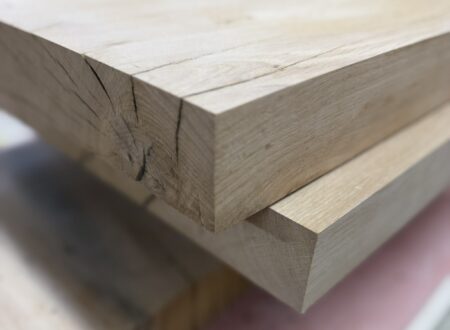
It’s made from English Oak sourced a few miles from the Bison Hill workshop in Surrey — timber that’s been air-dried for two years after felling, which removes the moisture that causes warping and cracking in lesser boards. The construction is entirely handmade: planed flat, smoothed, triple-sanded, and finished with food-safe Danish oil that penetrates the grain and protects without coating. One edge is left entirely natural — a live edge that gives each board its own profile. The other three edges are cut straight for practical use.
At approximately 7 cm thick, the BBQ Block is butcher-block weight: substantial enough to stay in place on a kitchen counter, thick enough to absorb years of knife work without significant surface wear. It comes in three sizes — 30–40 cm × 40 cm (£99), × 50 cm (£125), and × 60 cm (£150) — to suit everything from a small flat kitchen to a large prep surface.
The multi-use design is one of its most practical features. The same board that handles daily vegetable prep doubles as a brisket carving board, a cheeseboard for entertaining, a serving platter for bread and charcuterie, or a presentation surface for a Sunday roast. One board that does the work of several — and looks good doing it.
If you’re looking for the best wooden chopping board made in the UK from properly sourced, properly finished English Oak, this is it.
See the Bison Hill BBQ Block →
How to Care for Your Wooden Chopping Board
A quality oak board will reward basic maintenance with decades of use. The rules are straightforward:
- Oil regularly. Apply Danish oil or food-grade mineral oil once a month (more frequently when new). Work it into the grain with a cloth, let it soak for 20 minutes, then wipe off any excess. This prevents drying and cracking.
- Hand-wash only. Never put a wooden board in the dishwasher. The combination of heat and prolonged water exposure will warp and crack any wooden board, however well-made. Wash with warm soapy water and dry immediately.
- Store flat. Storing a board upright allows moisture to distribute unevenly, causing warping over time. Keep it flat when not in use.
- Sand when dull. When the surface begins to look tired or show knife marks, a light sand with 120-grit then 240-grit paper will restore it. Follow with a fresh oil treatment and the board will look new again.
Frequently Asked Questions
Are wooden chopping boards hygienic?
Yes — dense hardwoods like oak are naturally antimicrobial. Research shows bacteria drawn into wood grain die off quickly and cannot reproduce, making a well-maintained oak board more hygienic in daily use than a scarred plastic surface.
What is the best oil for a wooden chopping board?
Danish oil or food-grade mineral oil. Both penetrate the grain effectively and are food-safe once dry. Apply monthly and after any deep clean. Avoid olive oil or vegetable oils — these can go rancid inside the grain over time.
How long does an oak chopping board last?
Decades, with basic care. A well-made oak board — oiled regularly, washed by hand, stored flat — will outlast years of daily kitchen use and can be resurfaced if it ever shows significant wear. It’s a generational purchase, not a replacement purchase.