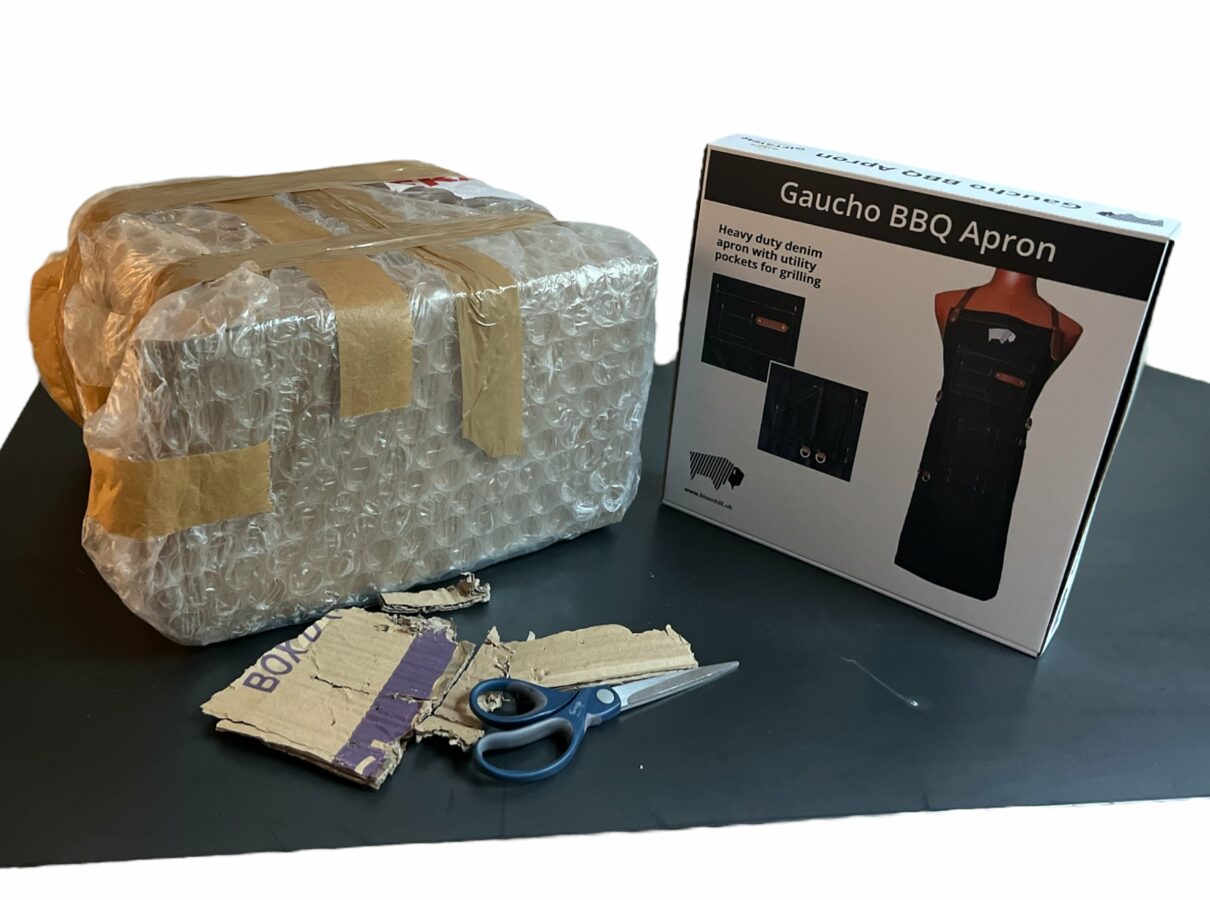
When we launched the Gaucho BBQ Grill Apron in November 2022, we faced a packaging decision that most new product businesses face: commission bespoke branded boxes, or find another way. Custom packaging for a first production run is expensive, slow, and commits you to a volume before you know whether the product will sell. We chose another way.
We decided to ship in repurposed, reclaimed cardboard boxes — what we called UGLY boxes. Whatever was on hand that fit the apron without crushing it. Double-walled where possible. Functional. Absolutely not branded.
The Worry
The worry was obvious: a customer who’d spent £75 on a premium product opening a beat-up recycled box might feel short-changed. The unboxing experience is part of the product story in 2022. Everyone knows this. We were going against it deliberately, and we weren’t entirely sure how it would land.
We included a note with every UGLY box shipment. Short, direct. It explained why the box looked the way it looked: we didn’t want to add cost for packaging that goes straight in the bin; we’d rather put the value into what’s inside. We asked customers to keep the box if they could, use it again, pass it on.
What Customers Said
The response was almost entirely positive. Several customers mentioned the UGLY box and the note specifically in their reviews. The phrase that appeared more than once, paraphrased: “turns up in a beat-up box but what’s inside is immaculate.” That contrast — deliberately rough on the outside, visibly high quality on the inside — turned out to work. It reinforced the message rather than undermining it.
The explanation mattered. Without the note, the UGLY box would have just looked like cost-cutting. With the note, it became a choice — and customers respected that it was a considered one.
From Apology to Feature
By the time we were reviewing year one in late 2023, the UGLY box wasn’t an apology anymore. It was part of the brand identity. Customers who’d ordered before knew to expect it. New customers arrived having seen it mentioned in reviews. It had its own story — which is more than most packaging ever achieves.
We’re not suggesting the UGLY box approach is right for every brand or every product. But for a brand built on the principle of putting value into the thing itself rather than the presentation around it, it turned out to be consistent. The packaging reflected the ethos. That consistency is what made it work.
The UGLY box still ships today. Nothing about it has changed — because nothing about it needs to.